Fatherhood is sleepless nights with a crying baby; it’s sleepless
nights with a sick child; it’s sleepless nights waiting up for a teenager; it’s
sleepless nights worrying about a grown child that lives far away.
Fatherhood is a lifetime of losing
sleep.
Fatherhood is working to pay for hungry mouths; working to
pay for new shoes; working to pay for a new baseball glove; working to pay for
a new bike; working to pay for family vacations; working to pay for braces;
working to pay for an extra car; working to pay for college; working to pay for
weddings.
Fatherhood is lifetime of work.
Fatherhood is fixing a bottle for a crying baby in the
middle of the night; fixing a baby monitor; fixing a tricycle; fixing a broken
window; fixing doorknobs; fixing holes in the wall; fixing dishwashers; fixing
garbage disposals; fixing garage door openers; fixing ceiling fans; fixing
stereo speakers; fixing TVs; fixing cars.
Fatherhood is lifetime of fixing
things.
Fatherhood is teaching a child to walk; teaching a child to
talk; teaching a child to sit still; teaching a child when to be quiet;
teaching a child to say “please” and “thank you;” teaching a child to brush
their teeth; teaching a child to read; teaching a child to pray; teaching a
child to catch a ball; teaching a child to do dishes; teaching a child to clean
their room; teaching a child to deal with bullies; teaching a child to share;
teaching a child to drive; teaching a child to balance a checkbook; teaching a
child to live on their own.
Fatherhood is lifetime of teaching.
Fatherhood is listening to the deafening sound of a sleeping
baby; listening to toddler’s questions; listening to screaming voices at play;
listening to sad tales about owies; listening to complaints about household
chores; listening to dreams; listening to loud music; listening to “You don’t
understand;” listening to “I can’t wait to get out on my own;” listening for
the phone to ring and hoping it will be a call from your son or daughter that
has moved away.
Fatherhood is lifetime of listening.
Fatherhood is the loving coo of a newborn; it’s the squeeze
around the neck from a five-year old; it’s the happy smile of ten-year old;
it’s the high five or knuckle bump form a teenager; it’s the warm embrace of a
grown son returning home for a visit; it’s the last hug from a daughter before
you give her away on her wedding day; it’s the hugs from grandkids on your lap;
it’s the kiss on the cheek and a tear in the eye as your life passes.
“A qué se dedica?”
asked our guide. He and I were riding our horses along the beach behind the
group and talking about life. He wanted to know what I did for a living.
“Soy piloto,” I
answered with a smile.
He grinned. “Ah, that why you not afraid.”
I shrugged and grinned back. Then I urged my horse forward
and galloped down the beach past the rest of the group as they plodded along in
the sand. It was our last day in Costa Rica, and I was going to squeeze a few
more drops of excitement from the adrenaline-filled trip. I wanted one more day
of Pura Vida.
Pura Vida is a
common expression in Costa Rica. Literally translated, it means “Pure Life,”
but expressions like that can’t be taken too literally. Pura Vida means a “good life,” “full of life,” or “living great.”
On our second trip to beautiful Costa Rica, I was starting to understand what
the “Ticos” meant.
When my wife Britt and I began planning a trip to celebrate
our 25th wedding anniversary, Costa Rica was high on the list. We
had enjoyed a trip there before a few years ago, and always wanted to go back.
When we did some comparisons based on cost and available activities, we decided
that another trip to the land of Pura
Vida was in order.
It is considered a professional standard for pilots to be cheap.
I had deviated from that standard slightly when I purchased Britt a first-class
ticket for the trip, but I redeemed my image by jump seating (at no cost) myself.
It was a good balance. We traveled with two other couples, Kelly and Leroy, and
Kim and Glen, and because of separate bookings, we traveled in two groups. I
almost got left at the gate in Phoenix because of a paperwork snag, but in the
end my friend Lori (who was flying the Airbus) helped me work it out, and I
boarded.
After a night in the Adventure Inn, an adequate hotel with
friendly staff, the guides from Pacuare Lodge picked us up around 0545 the next
morning. We piled into a small bus and headed out into the mountainous rainforest
east of San José to embark on our first adventure – whitewater rafting. Heavy
with people and luggage, the suspension of the bus bottomed out on the rough
road. We visited with Pepe, one of the guides, and exchanged riddles in Spanish
until we ascended into the clouds and stopped at a restaurant for breakfast. We
ate the typical breakfast of eggs with black beans and rice as the fog swirled
and obscured our view. The adventure began when the bus started down the steep
switchbacks overlooking the swollen river. Everyone grew quiet and prayed the
brakes were better than the suspension. Pura
Vida!
We piled out of the van with a few pale faces and grabbed a
helmet, a paddle, and a life vest. My helmet was adorned with blue scuffmarks like
someone had smacked it with one of the paddles. I wondered if it was a sign of
things to come. Ivan gave us the safety briefing, but I wasn’t as attentive as
I probably could have been. It’s hard to think safety when your bladder is full and
the sound of rushing water is all around you. While he was giving us the
briefing, one of the departing rafts capsized and dumped everyone out. I
checked the water. It was cold.
When we finished the safety briefing (and took a potty
break), we shoved off with our guide José Luís. His English was good, but not
as good as his smile and good humor. José Luís put Leroy and me in front. That
made me nervous. I was going to get soaked. Sure enough, as we pushed through
the first rapids, I got soaked. After that, I relaxed. I figured that getting
wet was most likely the worst thing that would happen to me that day. Pura Vida!
We laughed and enjoyed the spectacular scenery. The gigantic
tropical trees along the river supported several canopies. The river was the
color of coffee with cream because of the recent rainstorm, and even though the
water was cool, it felt good in the warm tropical sun. When we stopped to
explore a stream with a waterfall, we must have looked like some flock of strange
exotic birds with bright orange shirts, white helmets, and red life vests.
“Do we need to worry about wild animals?” asked Kim. José
Luís shook his head and smiled. “Just esnakes,” he said with a laugh. We kept
our eyes open.
After braving several rapids and learning to paddle
together, we arrived at Pacuare Lodge nestled in the rain forest along the edge
of the river. When we hung up our wet gear and sloshed up the riverbank to
check in, Andrés welcomed us with a pot of hot chocolate. While we sipped at
the chocolate and dried off he told us about the facility. Only the main
building has electricity and Internet. The teakwood bungalows sit on stilts overlooking
the river and come equipped with running hot and cold water, but no
electricity. When we walked up the
wooden steps onto the porch with a hammock and a river view, it felt like a
slice of paradise in the wild. Each open-air bungalow was furnished with a
king-size canopy bed and a gorgeous bathroom that included an outdoor shower
surrounded by a stone wall for privacy, if you wanted to shower al fresco. I
felt like I was taking a shower under a hot waterfall in the middle of the rain
forest. Pura Vida!
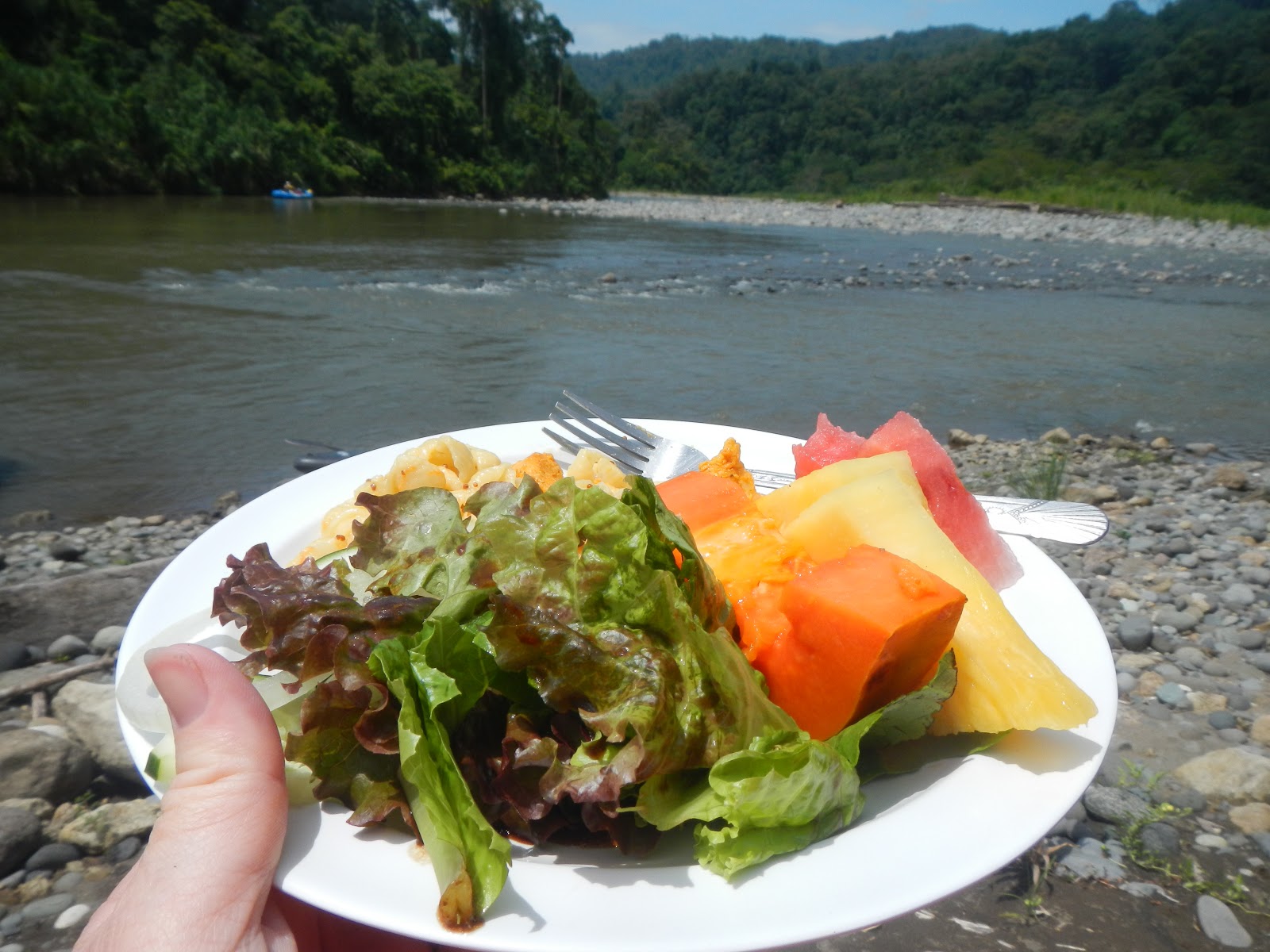
At Pacuare Lodge meals are served for everyone at the same
time with a set menu. If you think that just because you are in the middle of
the rain forest the food might consist of fruit and reconstituted foods, you
are mistaken. Lunch was a three-course meal. For dinner I had a spicy tomato
soup that was out of this world, followed by tilapia with rice, and passion
fruit mouse for dessert. For breakfast the next morning we had eggs with bacon,
fried cheese, and banana pancakes. If that wasn’t enough, Leroy talked them
into to bringing us a plate of oatmeal cookies after dinner, and they offered
coffee and hot chocolate in the afternoon. We ate so much the raft sat a little
lower in the water when we shoved off the next morning.
The second day on the river was even better than the first.
We traversed several good rapids and paddled through lush forest vistas with
waterfalls cascading down cliffs. A friendly competition emerged among the
paddlers on each side. Leroy started giving his side grief for not paddling
hard enough, and then talking smack when it appeared they paddled better than
us. When I asked José Luís if we could change sides, he hesitated, and then
very diplomatically told me in Spanish that he didn’t want to switch because it
would make it uneven. He said that he put my group on the side opposite of him
because Leroy’s side was weak. It was fun translating that. The smack talk
continued, especially when we went through a big rapid and I held up my paddle
and cheered instead of paddling. We laughed and cheered each time until at last
we passed under an old railroad bridge and pulled out next to their company
warehouse. Pura Vida!
After we showered off and changed into dry clothes, we
caught our transport to Tabacón. We had originally had scheduled for two rental
cars, but switched to private transfers instead. It was cheaper, and a much
better way to travel. We were able to take short naps and visit while someone
else familiar with the roads drove us to our next stop. One driver, Pablo, even
offered a wifi hotspot through his iPhone. It made the trip a lot less
stressful.
The Tabacón is a five-star, hot springs resort built at the
foot of the Arenal volcano near La Fortuna. It offers luxurious rooms with
rainforest and volcano views. Across the street is a hot springs river
surrounded by a manicured rainforest with a spa in the middle. They also offer
a swim-up bar where the pool is slightly warmer than bathwater. Up above the
entire complex is a restaurant that offers a nightly buffet. I think the first
guests here were Adam and Eve.
After a good night’s rest and a buffet breakfast, we headed
for Sky Trek/Sky Tram, a zip line adventure in the foothills surrounding the
volcano. Once again we donned helmets for safety and boarded the tram. Glen had
expressed his concerns over the event several times, but when he saw a
seven-year old boy on the tram, he swallowed his fear and manned up. After the
obligatory safety briefing and two practice zip lines, we hooked up to the
first cable and past the point of no return.
I stood on the platform trying to look past the trees and
see where I was going. Then the signal came over the radio, and the guide
pushed me off the platform. The next thing I knew I had zipped past the trees
and was soaring almost six hundred feet in the air! The wind rushed by and the
pulleys on the cable hummed as I felt something akin to flying. I felt small
against the backdrop of the volcano, the lake, and the sprawling forest. The
tiny platform on the other side looked like a beacon of civilization drawing me
in. I slid into the platform with a grin on my face and braked to a stop with
the help of the friction devices. Since I was the first to go, I was worried
that some of the others would chicken out, but when I stood on the platform and
filmed their arrival, all of them had the look of exhilaration on their faces,
especially Glen. When we finished I told Britt I wanted to be a zip line guide in
Costa Rica when I retire. Pura Vida!
The hot springs of the Tabacón balanced out our
adrenaline-filled morning. We relaxed under steaming waterfalls and wandered
from secluded pool to secluded pool soaking in the hot mineral water and
letting the tension of paddling the raft and the adrenaline of flying high
above verdant forests on a steel cable melt away. That evening we dined at the
buffet, and reported to the spa for a couples massage. I am not a regular
massage customer, and for Glen it was another first. They escorted each couple
to a private area behind the spa nestled among the trees. I could hear the
rushing water of the river mingled with soft meditative music as I lay on the
table letting the masseuse push all the cares of the world from my body and
mind. I was able to let the rhythm of my thoughts settle and pick up a cadence
that carried me to clarity. Pura Vida!
If soaring
through the air wasn’t enough, the next morning we headed out to rappel down
waterfalls with Pure Trek Adventures. At this point my fellow travelers accused
me of trying to kill them. It was our fourth day in Costa Rica and everyday we
had participated in something that required a helmet. I just smiled. After a
short drive up into the mountains in the back of a truck that reminded me of
being in the military, we filed out and got fitted with our rappelling gear –
including the helmet. Having rappelled several times, but by no means an
expert, I took special note of the gear, the ropes, the anchors, and the belay
system. By the time I saw the set up at the first 165-foot waterfall, I was
satisfied that we were in competent hands. Once again, Britt and I went first.
They made me wait as I watched her scurry down the cliff beside the rushing
water. When they gave me the green light, I found my rappelling legs quickly
and began catching up with her. Suddenly the guide on belay stopped me and
pulled me into the cool rushing water of the falls for my morning shower.
We high-fived each other, and stood at the bottom cheering
on everyone else. The guides followed the same pattern for the next few couples
until Kelly and Leroy started down. After dousing Leroy in the waterfall, they
decided to pull the already-terrified Kelly into the waterfall as well. That
induced a kicking and screaming fit, and when she finally got to the bottom she
punched the mischievous guide in the shoulder. (See video below.) By the time we finished the
fourth waterfall, Glen was over his fear of heights and Kelly was a pro. Pura Vida!
After another afternoon in the hot springs, and a very sound
sleep. We started our longest travel day from the center of the country to the
Pacific coast to Manuel Antonio and the town of Quepos. We took in the
countryside, a butterfly observatory, a fruit stand, and watched crocodiles
fight over pieces of meat - not exactly the same as driving across Kansas. When
we checked in at Costa Verde, we were ready for some down time.
Costa Verde hotel sits on the hillside above the beach and
offers spectacular views, including a B727 that has been converted into suites.
They boast that they still have more monkeys than people, and true to that
slogan, we saw several monkeys during our stay. At dinner across the street in
La Cantina we contemplated the remaining activities and decided to cancel our
guided tour to the national park the next day. Instead we would rent scooters
and spend the day on the beach. Then the last day we would go horseback riding.
In the process of helping a fellow traveler, I spoke with Fabricio Mengarelli,
the executive chef of La Cantina. Right away I noticed his Argentine accent. We
ate at his restaurant two nights in a row. The ribeye was excellent, and my
wife said the pineapple chicken was out of this world. If you are ever in
Quepos, go see Fabricio. Pura Vida!
To start our “relaxing day” on the beach, we rented scooters.
Of course, that meant putting on a helmet. We zipped down to the beach and got snookered
by the parking attendants alongside the road, but when I left the keys, I must
admit they were honest, and brought them to me. We overpaid for chairs and
umbrellas, drinks and burgers, boogie boards and a ride on the banana boat, but
Leroy used his negotiating skills to secure us some time on the wave runner
unsupervised. Between boogie boarding the nice easy waves, wrestling with the
wave runner, and getting thrown off the banana boat several times (I could not
stay on!), we topped it off with a game of soccer on the beach with the locals.
By the time we scooted back to the hotel, I was exhausted! Pura Vida!
After dinner at La Cantina, we hopped on to our scooters and
zipped down into Quepos to Escalo Frio in search of ice cream. We found the ice
cream, but while we were there we heard the rain start pounding on the tin
roof. It was coming down in buckets with no end in sight. We got the ladies a
cab and sent them back to Costa Verde. While we waited for the rain to subside,
Leroy and Glen sampled the pizza, but I was too stuffed with ribeye to eat.
When it became obvious that the only way we were getting back was through the
rain, we fired up our scooters and charged back up the hill amidst the
lightning. Cold rain pelted my face and pinged off of my helmet, but I was
grinning from ear to ear. Pura Vida!
Kim was worried about horseback riding the next day, since
it would be her first time. The horses were small and looked like they could
use some more oats, but they seemed docile enough. It turned out they were
maybe a bit too docile, except for mine. The guide was an experienced horseman
that paired us up with a horse based on our experience, and how we acted around
the animals. I got the horse that wanted to run. While everyone else prodded
their horses into a trot along in the sand, I got my horse to gallop circles
around them. After all the adventures we had completed by then, we were jaded.
What should have been an enjoyable ride on a beautiful beach, turned into a
slow trot in the sand. We had officially become adrenaline junkies and needed
more than a simple ride along the beach to impress us. As the end of the ride
came in to view, I spurred my horse into a run and galloped to the finish.
That afternoon it rained. We ate pizza again and took a
siesta. When the rain subsided that evening, Britt and I went for another ride
on the scooter. The undulating hills along the beachfront took us in and out of
pockets of cool air. We scooted along the deserted road looking for monkeys.
The moist wind felt good on my face. After twenty-five years, my wife’s arms still
felt good around my waist. Pura Vida!
If you want to book an exciting vacation of your own to Costa Rica, contact Catalina - info@crreferrals.com. She can help you find your Pura Vida!
When I was seven, my mother left for the hospital to
deliver. At the time I had one brother and four sisters, and was feeling a bit
outnumbered. I hoped that my parents would bring home a little brother and even
up the odds a little. When my Granny got the phone call and announced that my
parents would be bringing home a baby girl, everybody cheered, except me. I
broke into tears. I really wanted a little brother.
By the time my parents brought her home, I had resolved to
love, or at least live with, my new sister anyway. She was a cute baby (most
babies are) and quickly grew into a little towheaded girl with a special
birthmark just above her left hip. My parents named her Tassie. She turned out
to be a hard working, and helpful sister, and I soon forgot about crying the
night she was born.
Several months ago, I got a letter from Tassie explaining
that she and her family were going to pull the children out of school and go on
the road during the hard winter months of Maine. She wanted to know if they
could come and stay a week or so with us in Arizona. Although we had never lived
close to each other since we left home, we tried to keep in touch across the
miles. It would be a great opportunity to reacquaint ourselves. How could I
refuse? (Maybe I still felt a little guilty about crying when she was born.)
So a few weeks ago, Tassie, her husband Randy, three of
their daughters, Gabriela, Mirette, and London, came to visit us in Arizona and
escape the wintry weather of the northeast. Maine is a bit different than
Arizona, especially in March. While Maine was suffering under yet another
winter storm, we enjoyed beautiful sunny weather all week long. We gladly made
space for them to sleep, and room for them at the dinner table. They integrated
quickly and became part of the family.
Mirette Swimming
It was fun to watch and interact with my nieces and get to
know them better. Brie is a young woman now, almost ready to tackle life on her
own. Mirette is a soft-spoken redhead (yes, they do exist). London is my
sister’s “mini-me” right down to the platinum blonde hair and the funny
comments.
Mirette, along with her father, wanted to catch all the
critters that roam in the warm desert climes, like tarantulas, lizards and
scorpions. One evening, armed with a black light, a glass jar, and a pair of
tongs, they went out searching for scorpions in my father-in-law’s half-acre
backyard. They were not disappointed. They came to the back door with a
scorpion as long as my index finger scurrying around the bottom of the jar.
Under the black light he looked otherworldly.
Tassie asked London, “Do you
want to see the scorpion?”
“No,” replied London without
hesitation.
“Why not? Maybe we’ll take it
back to Maine with us. Do you think we can tame it?”
London eyed her mother with a
serious face. “I don’t want to tame it. I want to kill it.”
Out of the mouth of babes…
Britt and London Driving the Boat
Most of us in Arizona don’t go swimming in our pools until
May because the water is still too cold for us, but they swam almost everyday
in the brisk water as if it were as warm as bathwater. I had to heat up the hot
tub before I got in. We took them out on the boat and pulled them on the tube.
They had on life jackets and wetsuits to keep them warm, but I don’t think
really needed them. They begged me to go on the tube with them, but I lasted
about thirty seconds. After one spill, I got back in the boat.
A couple of days before they left, a good friend of mine
took them up flying. It was another perfect spring day in Arizona with a clear
blue sky stretching to the desert floor. After takeoff, each of them got a
chance at the controls. My sister was so nervous her hands were shaking, but
Brie took to it like a natural. It gave them a new perspective. When they
landed, they told me it was the most fun thing all week.
We played games and talked about politics, good books, and
movies, but not necessarily in that order. We ate a lot of good food, but we
especially liked the way Randy cooked and prepared vegetables. We tried to
convert him to dessert, but he continued to resist our temptations (oh well, more
for us). It was like catching up on the experiences of a lifetime in one week’s
time.
It was another beautiful spring day in Arizona when Tassie
and her family piled into their minivan and headed for my other sister’s house
in Los Angeles. We all hugged goodbye, and we wished them a safe a journey. It
had been a wonderful week full of love and excitement. I may have the cried the
night Tassie arrived, but this time I cried inside when I watched her, and her
family, leave.
The other day I pulled an old box of souvenirs from a shelf
in my closet. My daughter needed a few things for a school presentation, but in
addition to the items she needed, I found an old journal of mine.
The pages were yellowing and exuded that musty smell that
only comes from the pages of a dusty old book. I thumbed through the various
entries I penned over thirty years ago, and it brought back a flood of emotion.
I felt all of the anxiety and uncertainty associated with those first few years
when you leave home. I read about fun times with friends, trouble with school,
and the roller coaster of emotions caused by relationships. I read through my
struggles as a missionary and all the people that touched my life. Some of it
made me laugh. Some of it made me cry. Some of it needs to be ripped from the
journal and burned before anyone else reads it.
On my twentieth birthday, I was in Carmelo, a small coastal
town in Uruguay, serving as a missionary, and Branch President. Based on my
entries, I was struggling under a heavy load, and very inexperienced at life.
On March 6, 1983, I wrote, “Time is a real paradox; you never have enough, yet
there is always a little to kill.” As I turn fifty, I couldn’t agree more. Time
is an irreplaceable commodity that we often misuse.
Each decade of my life has been full of challenges and
accomplishments. As I turned twenty, I was concerned about choosing the right
path for my life. As I turned thirty, I was concerned about providing and
caring for the children entrusted to my care. When I turned forty, I didn’t
know what to expect. I worried that it might all be downhill from there. Now
that I have finished my forties, I must admit that they were good years. It was
a decade of accomplishment.
Since I turned forty –
My wife and I adopted two daughters from Russia. When you
are driving down the street with your former enemies’ castaways seated
comfortably in your new minivan, you won that war.
I bought and paid off a new minivan – not exactly a small
feat if you have priced minivans lately.
I ran two marathons. I might have run a couple more, but I
got sidetracked with the adoption and back surgery.
I survived a serious back injury and back surgery. I don’t
help people move any more, even though I have a truck.
I bought and paid for a new truck. It wasn’t quite as
expensive as the minivan, but then again the minivan can’t pull a boat.
I bought a boat. Well, everyone is entitled to a mid-life
crisis in their forties. The boat is a beautiful red and black, and it was much
cheaper than the mistress, and subsequent divorce that follows. Besides, I
share the boat with some great friends.
I made a lot of new friends, and strengthened old
friendships. That is not an easy task for a guy that travels for a living and
prefers to be alone, but I managed to make friends with some of the best people
in the world. I think it’s because of my very friendly wife.
I stayed married to the same woman. Judging from all the sad
divorces I have witnessed, I would say that staying married wasn’t an easy
task. Unfortunately, I would attribute most of the marital bumps in our road to
my personality.
I struggled with the same weaknesses that have plagued me
for years. I would like to say that I have overcome many of them, but then I
would have to add lying to my list of weaknesses. I still struggle with anger,
selfishness, jealousy, and sometimes I allow myself to slip into a state of
melancholy. I continue to work on my weaknesses.
I took piano lessons and learned to play basic songs on the
piano, but then promptly gave it up for a new hobby that captured my passion.
I started writing. Out of arrogance, I decided that I would
write a novel. Who knew how difficult that would be? As of this blog, I haven’t
published a novel, but I have written two manuscripts that are being shopped
around. I did manage to publish a couple of small essays.
I started this blog. It has been fun and interesting putting
my thoughts out there for the world to see. I have been cautious about baring
too much of my soul, but I have enjoyed sharing bits of my life through this
unique forum.
When I was twenty, forty seemed so far away, and I was
certain that the best years of my life would be behind me by my fortieth
birthday. Most of my fears about my forties were unfounded, and I look back on
the journal entries of my twenty-something self and laugh. My forties were good
years. I think of all the decades I have lived so far, I would prefer to repeat
my forties more than any other decade.
Now that I am turning fifty, I recognize even more that time
is a precious commodity. If I’m going to kill time, I want to work it to death
while engaged in some cause worthy of the seconds, minutes, and hours that I
will never regain.
As I turn fifty, I wonder
if the best is still yet to come.
“Use
the time of a total stranger in such a way that he or she will not feel the
time was wasted.” Kurt Vonnegut
I have been writing this blog for two years now. I have no
particular theme or slant. I have written essays from the heart and sprinkled
in a few short stories. I started out writing two blogs a month, but then
thinned it out to one per month because, frankly, I had less to say, and I
didn’t want to waste your time with drivel.
As a commercial pilot, the best adjective I can use to
describe a successful day is – uneventful. Nothing out of the ordinary
happened. I didn’t have to deal with any life-threatening emergency. Everyone
behaved. The weather cooperated. Eventful days are the days when things go
awry, and I really earn my money. I prefer the uneventful days.
I can’t say that I prefer an
uneventful life.
So, here I sit at my computer trying to come up with a blog
for February, but nothing is coming to me because January was, you guessed it,
uneventful. That’s not to say the nothing happened. We rang in the New Year. I earned
my wage with several uneventful days at work. I changed burnt out light bulbs
and made the usual household repairs. I went to soccer games, volleyball games,
and school events. I enjoyed birthday parties, and social events with friends. I
had long talks with my children, and meaningful conversations with my wife. I
dealt with the drama of daily life. My calendar was quite full, but for the
most part the month was uneventful.
So, where does that leave this blog? Do I waste your time
describing an uneventful month?
I recently read a novella titled, “A Short Stay in Hell” by Steven
L. Peck. It was an intriguing story where the protagonist dies and finds
himself in a special type of hell. He is sent to the Library of Babel, as
described in the classic short story by Jorge Luis Borges. It is a vast library
that contains one authentic volume perfectly describing each person’s life,
along with all the possible variants. It doesn’t sound like such an expansive
library, but when you do the math the minimum number of books looks something
this – 251,312,000.
Based on the average size of a book, the Library of Babel could contain
enough books to fill the entire known universe.
The protagonist could leave hell the moment he found the
volume that accurately depicted his life. Accurately meaning that it included
all the events and had no errors (misprints, misspelled words, incomplete
sentences). He was immortal and could take as long as he needed to find the
book. Since there was a finite number of books, and he had unlimited time,
theoretically, he would eventually find the book and be released from hell. The
only problem is that most of the books were full of gibberish, and with that
many books on the shelves, that’s a universe full of nonsense.
So what do an uneventful January and the Library of Babel have in
common?
The truth is that if we wrote down all of the menial daily
events in our lives, much of our book would be filled with pages of
insignificant sentences, and paragraphs of empty prose. Who would want to read
about every banal act of living? Do you care about my struggle to balance my
budget or keep the yard clean? Why would you care to review how I cleaned the
kitchen or disinfected the kid’s bathroom? What a snoozer it would be if the
book only contained the tale of toil that makes up our daily lives. Like the books
in the Library of Babel, our lives can easily be filled with gibberish.
So we press forward everyday, wading through the waters of banality
hoping for something eventful. At the same time we fear the unknown lurking
beneath that water, and we refuse to plunge into the deep waters of the
extraordinary.
Will we accomplish anything today worth reading about a
hundred, a thousand, or a million years from now, or will the story of our life
be like one of the books in the Library of Babel full of random characters
without meaning? How do we put together at least one complete sentence in the
story of our life that will stand for eternity?
The other day I bought cinnamon rolls at the supermarket.
When the grey-haired gentleman bagging my groceries stuffed the rolls into the
bag he said, “My wife used to make these all the time.” I could see tears in
his eyes. I could only assume from his age, and the emotion he displayed over
the rolls, that his dear wife had passed and left him alone. Would you consider
a story about a woman cooking her husband cinnamon rolls significant enough to
read? It doesn’t seem like much, but it was enough to evoke deep emotion from
the man.
My wife has taught me to value relationships more than
things. Admittedly, I have been a slow learner. If we want to fill the book of
our life with anything other than gibberish, it must include paragraphs of daring
dialogue, pages of shared human experiences, and chapters about our service to
others. The only words that will give the prose from our book any lasting
meaning, are the words we write in the tablets of the heart.
If we want an eventful life filled with meaning, we must
nurture relationships with our fellow human beings. After a thousand years the
only sentences that will carry any meaning, are the ones we wrote with the ink
of love upon the pages of friendship. This Valentine’s Day write one complete sentence in your
life’s book filled with words, and deeds, of love that will stand the test of time.
It was clear winter night with a sliver of a moon and the
visibility from thirty-seven thousand feet was a hundred miles. Both the Big
Dipper and Orion hung bright in the sky, and I felt like if I stared into that
starry sky hard enough, I could look into God’s eyes. But instead, my emotions
pulled me, and my gaze, earthward. I was passing over Kentucky.
Years ago I read a science fiction short story by Philip
José Farmer that I have never forgotten. The crew of an experimental starship
manages to exit the outer boundary of our universe only to find other
“universes” floating in space. When they realize where they are, it takes
everything in them not to panic from the homesick feeling that overcomes them. He wrote - “It takes a special type of
man or woman to lose himself from Earth or his native planet, to go out among
the stars so far that the natal sun is not even a faint glimmer. It also takes
special conditioning for the special type of man. He has to believe, in the
deepest part of his unconscious, that his ship is a piece of Mother Earth. He
has to believe; otherwise, he goes to pieces.”
No matter how far we go. No matter how high we fly. No
matter the distance through time or space. We always anchor ourselves in a
singular reference – Home.
We were travelling west and our flight path took us just
south of Lexington, almost over the top of Elizabethtown. Off to my left the
lights of Nashville beckoned, as they have beckoned to many a dreamy-eyed
singer hoping for country-music fame. On my right the lights of Louisville and
all its commerce filled the horizon. A ribbon of highway full of headlights and
taillights connected the two cities. My eyes were looking for the lights of the
truck stop on I-65 not far from the farm where my parents still live.
A strange feeling gripped me as I followed the lights and
zeroed in on the farm. I felt like a little child standing in front of the
living room window with his nose against the glass as the ice cream truck
ambles by. I felt like the child at the school bus window as he watches his
mother wave goodbye and disappear from sight. I felt like the lonely college
student stuck on campus during the holidays because he didn’t have enough money
to go home. I felt like the soldier deployed to a far away land staring at the
horizon wondering about his family. I felt like the tourist on vacation that
even amidst all the fun and revelry, suddenly feels empty. Yes, we have all
felt that feeling, and even after all these years of traveling for a living, I
was homesick.
Homesick is a funny word. It almost sounds like you are sick
of home, which is the feeling that most teenagers feel as they approach the age
of maturity and can’t wait to get away from home. Or maybe a sickness has
invaded the home. Using the word “sick” leads one to believe that it is an
actual illness. Judging from the feeling in my stomach that night, I would
describe it as a sick feeling indeed. Interestingly enough, it is a sickness for
which there is no cure. You can suppress it, distract it, and work it to death,
but you can’t eradicate that feeling. You can temporarily suspend it by going
home, but as soon as you leave the comfort of your home, the deadly disease
comes right back. Homesickness simply has no cure.
Within a matter of minutes we crossed the Mississippi river
and put Kentucky behind us.
I sat there pondering the nature of our modern society and
the speed at which it moves. With a click of a button we can connect to
thousands, perhaps even millions, of people all over the world. We can share a
snapshot of our life and display it for anyone, and everyone, to see right from
the palm of our hand. In a matter of hours, not days, we can cross the globe in
relative comfort and ease. We rush from place to place in planes, trains and
automobiles always trying to arrive somewhere. We seem to have this incredible
itch to move and connect that can never be satisfied.
A while later on the same flight, we passed just north of
the little town of Burkburnett, Texas. Once again I followed the lights of the highways
and streets and could barely pick out the first house my wife and I built. That
feeling of homesickness came right back, but this time I was sick for the
family she and I had made together. I thought about the memories of that house
in north Texas, and all the other houses we have lived in. I thought about all
the birthday parties, family dinners, school functions, sporting events, and
trips to the emergency room. I got the overwhelming sensation that I was
detached from life and watching it from a distance. Homesickness has no cure.
In our modern world it is
easy to go through life feeling slightly detached; like we are always waiting
to arrive somewhere; like we are on a journey that never seems to end; like we
are strangers in a strange land. Just like the star voyagers in the story, the
only thing that keeps us grounded is the firm belief that no matter how fare we
travel, we are always connected to home. The only cure for homesickness, is to
go home.
I was nervous when I got out the big ladder and prepared to
climb up on the roof. It had been several years since I had ventured up there
to put up Christmas lights, and the last time I went up there, I broke a tile.
I’m not afraid of heights, but I’m not too keen about falling. I had on a new
pair of running shoes with lots of grip when I climbed up the ladder and
shimmied onto the roof over the garage.
For several years I let my older boys do all the work on the
roof. That made me nervous too, but I figured they were much more nimble than I
was, and besides they are young and recover from injury much more quickly. Last
year I paid the kids to put up the lights. They needed the money, and I didn’t
really have time to get them up. This year I had a few days off before
Thanksgiving and decided to tackle the job myself.
I made the first trip to Lowe’s and got replacement lights,
but when I got home, my wife informed me that she wanted to change out all of
our Christmas lights. Back I went to Lowe’s, but I was smart enough to insist
that she come along and pick out the lights. (I’m not a newlywed.) She picked
out multicolored LED lights for the house, and color-coordinated lights for the
trees. I couldn’t see it working out that well, but I saluted smartly and paid
for the lights.
I decided to tackle the lower lights first. I got up the
first section and turned them on. They weren’t as bright as I thought they were
going to be, but after consulting with the wife, I pressed on. That’s when I
realized that I was going to be short some fasteners and went back Lowe’s for
more. Of course, they were out of the fasteners I needed. I headed to Home
Depot, and thankfully, I found them. So after four trips to the store, I was
ready to climb up on the roof.
It was late afternoon when I tiptoed across the tile roof
and got into position to hang the upper lights. The weather was perfect – no
breeze, clear skies, and seventy degrees. All of you living in Northern climates,
eat your heart out. I strung out the lights and started hanging them on the
upper eaves of the house, carefully watching my foot placement and avoiding the
edges of the roof. After a few minutes I got comfortable, but as soon as I
realized that I was comfortable, I made myself get nervous again. Complacency
kills. I didn’t want my gravestone reading, “Died while hanging Christmas
lights.”
A funny thing
happened while I was up there on my roof. Neighbors began to stop and talk to
me as if I were standing in my front yard. Now, I live on a street akin to
Mayberry, or maybe Beaver Cleaver’s neighborhood. So, it isn’t uncommon to see
people out in their front yards prattling on about life, but I guess I never
expected it to happen while I was hanging out up on the roof of my house.
One neighbor and I chatted about the recent election and gun
sales, two things that seem unrelated, yet are not. Another stopped and related
a story from his recent mission trip to Ghana to build a school. I was
fascinated and moved by his compassion, but I was more impressed by the
response of the people he helped. It made me realize how ungrateful I am for
modern conveniences. Another neighbor stopped and talked to me about his job
and invited me to check out their new facility (an aircraft maintenance hangar).
I visited with the neighbor kids across the street while they jumped on the
trampoline. People waved and greeted me as they went to the mailbox, or took
their dogs for a walk. It was like being on the roof made me more accessible,
or friendly, or maybe they were just worried that I would fall and they wanted
to make sure their last words to me were friendly ones.
In spite of all the friendly interruptions, I managed to
hang all the lights on the upper roofline and climb down without breaking any
tiles or falling off. As the darkness approached, I stood in the street and
admired the lights. The color scheme my wife picked out was perfect. The
lights, although simple, brought the holiday spirit. I have to admit I enjoyed
getting up on the roof this year. I especially liked how it attracted passing
neighbors, and wondered if maybe I should get up there more often.
My experience on the roof reminded me of the scripture from
Matthew, “What I tell you in darkness, that speak ye in light: and
what ye hear in the ear, that preach ye upon the housetops.”
(Matthew 10:27) The colorful lights weren’t the reason for the season. I went
to the garage and pulled out my favorite part of the decorations – the nativity
scene. I fixed the spotlight over the nativity scene, centered it on the baby
Jesus, and illuminated a depiction of the most important birth in the history
of mankind.
I was driven to writing by my own arrogance. In January of 2009, I finished a book by a popular author and was very unimpressed. I turned the book over and saw that it was a NY Times best seller. “I could do better than that,” I mumbled under my breath. So I began to dabble in writing and pondered various book ideas. Although I didn’t share my writing with anyone for several months, I found that I thoroughly enjoyed my writing time and found myself eager to get back to my computer. Writing gave me new purpose, and filled an emotional void in my life. It allowed me to be creative. I began sharing my work and was encouraged. I attended Orson Scott Card’s Literary Boot Camp, and came away with greater desire and respect for the writing craft. Today, I am still arrogant enough to think that I can succeed, but not so naïve that I think success will come without great struggles and many failures.




 If soaring
through the air wasn’t enough, the next morning we headed out to rappel down
waterfalls with Pure Trek Adventures. At this point my fellow travelers accused
me of trying to kill them. It was our fourth day in Costa Rica and everyday we
had participated in something that required a helmet. I just smiled. After a
short drive up into the mountains in the back of a truck that reminded me of
being in the military, we filed out and got fitted with our rappelling gear –
including the helmet. Having rappelled several times, but by no means an
expert, I took special note of the gear, the ropes, the anchors, and the belay
system. By the time I saw the set up at the first 165-foot waterfall, I was
satisfied that we were in competent hands. Once again, Britt and I went first.
They made me wait as I watched her scurry down the cliff beside the rushing
water. When they gave me the green light, I found my rappelling legs quickly
and began catching up with her. Suddenly the guide on belay stopped me and
pulled me into the cool rushing water of the falls for my morning shower.
If soaring
through the air wasn’t enough, the next morning we headed out to rappel down
waterfalls with Pure Trek Adventures. At this point my fellow travelers accused
me of trying to kill them. It was our fourth day in Costa Rica and everyday we
had participated in something that required a helmet. I just smiled. After a
short drive up into the mountains in the back of a truck that reminded me of
being in the military, we filed out and got fitted with our rappelling gear –
including the helmet. Having rappelled several times, but by no means an
expert, I took special note of the gear, the ropes, the anchors, and the belay
system. By the time I saw the set up at the first 165-foot waterfall, I was
satisfied that we were in competent hands. Once again, Britt and I went first.
They made me wait as I watched her scurry down the cliff beside the rushing
water. When they gave me the green light, I found my rappelling legs quickly
and began catching up with her. Suddenly the guide on belay stopped me and
pulled me into the cool rushing water of the falls for my morning shower.


