The Truth About Happiness  

Posted by Brock Booher

Why do we suffer from unhappiness and depression when we are doing our best to be obedient to God’s commandments? Aren’t we supposed to be happy? Isn’t it called “the great plan of happiness?” (Alma 42:8) If “wickedness never was happiness,” (Alma 41:10) then does that mean unhappy people are wicked? Is disobedience and wickedness the source of our unhappiness?

We sometimes confuse what is TRUE and what makes us happy.

We know that eventually we will understand all truth, and that truth is independent of opinion, or emotion. In other words truth can stand alone, regardless of how we feel. We do not understand all truth in this mortal existence. We seek the truth and welcome any revealed truth, but in reality the circle of truth we understand is quite small.
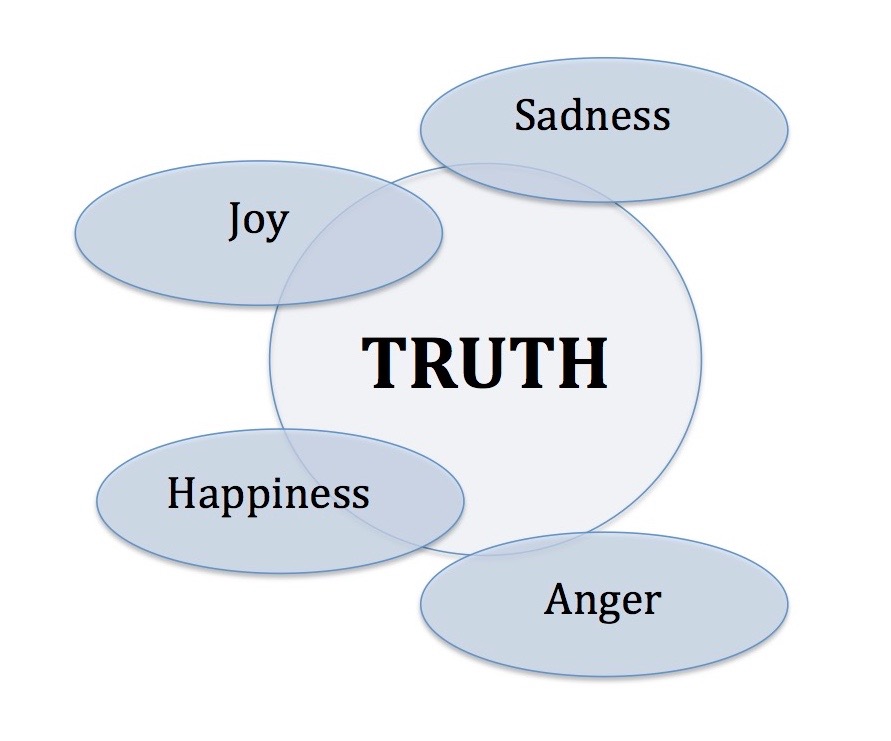
The emotions we feel (although very real) do not always represent, nor are they in line with, the truth, especially in this mortal life. We are intended to feel a variety of emotions in this lifetime, some of them very acute at times. We are designed to be happy. We are intended to have joy. However, we are not guaranteed a life without unhappiness. We are not promised some utopian existence where we live in constant harmony and never feel the wide range of emotion attached to our mortal journey. We will feel negative emotions, but those emotions do not change the truth. Truth stands alone, independent, and unaffected by emotion. It does not feel. It simply exists. Knowing and applying truth can bring us happiness, but unhappiness in this life does not mean that we have failed to understand or apply the truth properly. God makes the rain fall on the just and the unjust. Unhappiness comes to the righteous and the wicked, at least for now.

If we follow the PLAN of happiness, eventually we will be happy. (That’s why it’s called a plan.) If we align ourselves with the revealed truth and follow the plan, we will eventually achieve a state of happiness that is unchanging. Just as our bodies will be resurrected and glorified, our spirits will be free from guilt, shame, and all the other impediments to eternal happiness. We will have a fullness of joy. But for many that will not be achieved in this lifetime because of the mortal limitations of our existence.

So what do we tell someone who is suffering from depression and unhappiness? How do we console them and reassure them when they can no longer be happy in spite of their best efforts to live a righteous life? What do we say to someone who cannot seem to find happiness for the moment?

First, testify of truth. The truth doesn’t change with our emotions. It is constant. People suffering from depression and anxiety often describe it as a state of uneasiness or instability where they can’t seem to find their footing. They are looking for something—anything—they can hold onto. Depression and anxiety can rob a person of hope, and hope is the seedbed of faith. Without hope it is difficult to wait on the Lord and difficult to believe in anything we cannot physically experience. Revelation becomes difficult. Truth is the ultimate anchor in this situation. When we testify of truth it gives a reference and an anchor point in the sea of emotion. Truth provides stability in an unstable moment.

Love. We must fill our bowels with charity and serve those who are suffering. We are instructed to “lift up the hands which hang down.” (Hebrews 12:12) No one’s hands are hanging lower than someone suffering from depression or anxiety. Depression often robs an individual’s ability to feel joy and love. It makes it difficult to give and receive love. Because of this, it is often difficult to love someone suffering from depression because they cannot reciprocate or appreciate the love that is offered. “Charity suffereth long.” (1 Corinthians 13:4) We must love, and continue to love in a variety of ways, all those suffering from depression and anxiety. Love will see them through the darkest days.

The truth about happiness is that in this life we may not always be happy, even when we are trying to be obedient to God’s eternal laws. “In the world ye shall have tribulation: but be of good cheer; I have overcome the world.” (John 16:33) Life is a journey full of tribulation and emotion, but if we follow the plan of happiness we will eventually overcome all the mortal impediments to happiness.

Truth stands independent of our emotions.


Hopes for My Grandchildren  

Posted by Brock Booher

I’m going to be a grandpa!

How did this happen? How did I suddenly become the old guy in the room? I don’t feel old (at least most days). I certainly don’t think of myself as the sage voice of wisdom that grandparents are supposed to be. I don’t act like a grandpa (except maybe when it comes to my taste in music). I don’t think like a grandpa, but then again I’m not sure how grandpas think. What kind of grandpa will I be?

I don’t remember much of my paternal grandfather other than he was a mountain of a man that died way too young. My maternal grandfather, Grampy, survived into my adulthood.  I remember him vividly, and revered him as great man of knowledge, wisdom, and experience. Because of my experiences with him, I have always deemed grandfathers as this repository of life experience and sage advice. I’m not sure I’m ready for that role.

What do I hope to offer my grandchildren? I hope I can impart the same things that my Grampy tried to impart to me—experience, knowledge, and wisdom.

Imagine if you could give a grandchild the gift of experience. You could save a grandson a great deal of heartache and trouble because he could learn from your experience and not have to suffer through his own mistakes. You could give a granddaughter just learning to drive your years of driving experience, and help her avoid accidents. You could give a new married couple the gift of experience at raising children, managing a household, or learning to get along. If you could simply bequeath your life experience to your grandchildren, imagine the pitfalls and regrets they could avoid.

History repeats itself because we cannot pass on the experience of history to the next generation. It is true that I can teach my grandchildren and tell them stories that they can learn from, but if I could somehow transfer my experience to my grandchildren, they would be years ahead.

But life doesn’t work that way. The next generation must always learn some things from their own experience, not from the experience of those who have come before them. We cannot magically pass on our experience.  Every generation must experience life for themselves.

Modern technology has allowed us to download and transfer information from one electronic repository to another at an incredible rate. Yet in spite of all of the information available at our fingertips, the human brain still garners knowledge bit-by-bit and piece-by-piece through the study and practice. Imagine if we could simply plug our brain into a source of knowledge and download knowledge from a computer. What if I could transfer all the knowledge I have gained through the diligent effort of a lifetime to my grandchildren with the click of a mouse?

Having more information at our fingertips does not make us more knowledgeable. Information is not the same as knowledge. Facts don’t automatically make us smarter. Knowing the science behind hitting a home run does not make us a superstar in the major leagues any more than knowing the lines of all of Shakespeare’s plays will win us an academy award. The availability of information can accelerate learning, but each generation must gain knowledge through study and practice.

And what about the gift of wisdom? Think of the regret you could save a grandson or daughter if you could somehow transfer your hard-earned wisdom to them while they are still young. Your grandson would be wise enough to save a little money each week. Your granddaughter would be wise enough to avoid drugs without any anti-drug campaigns. Imagine that like a bank account we could transfer the wisdom we have garnered over the years to our grandchildren’s account. They could avoid a multitude of dead-end pathways, fruitless endeavors, and painful regrets.

But wisdom is gained at the cost of failure. Wisdom is paid for with a price. We can be wise and learn from the mistakes of previous generations, but we must also personally experience the heartbreak of some failures in order to gain personal wisdom.

Perhaps instead of wishing to pass on any knowledge, experience, or wisdom I may have collected over the years, I should help my grandchildren understand how to gain those precious gems for themselves. I can help them experience the sunrise of a winter day and the sunset of a stormy summer evening. I can teach them that trying and failing is better than not trying at all. I can show them that learning is the one activity that never grows stale. I can testify that knowledge is worth the effort, and that wisdom gained too easily can be just as easily lost.


I will do my best to impart any experience, knowledge, or wisdom that I have collected throughout my life to my posterity, but in the end I hope I can instill in them the courage to live and learn.

Love vs Trust  

Posted by Brock Booher

I got hustled at a convenience store the other day. A middle-aged man hit me up for gas money with a sob story about trying to get his painting business off the ground. He told me how much he loved God and how he was a hard worker, he even flattered me with a compliment. Awkward. I didn’t believe his story, his compliment, or even his commitment to God, but I gave him some gas money and sent him on his way. When I paid for the gas, he hurried out to the pump without so much as a thank you.

I shook my head and laughed. It felt good to help someone in need, even when they probably didn’t deserve it and didn’t appear to be grateful for it.

Scottish author and Christian minister George MacDonald said, “To be trusted is a greater compliment than to be loved.” How true! I didn’t trust the man in need, but I loved him enough to give him gas money. I didn’t believe his story, but I loved him enough to offer up a small token of my charity. Love is very different than trust. Love, or charity, will conquer all, eventually. But in the meantime, I must be careful with my trust. Love I must offer freely. Trust I must value more than gold.

We are facing a similar crisis of trust, or question of confidence. Do we follow our Judeo-Christian values to help our fellow man and allow Syrian refugees into our country and communities, or do we listen to the centuries-old intuition of self-preservation and keep them at a distance? Which counsel do we trust? The fate of our entire Western Civilization may very well be determined by how we answer this internal question.

One must take risks to win wars. Generals and Sergeants do not become famous without bold action laden with great risk. Risk is inherent in conflict, and to win a conflict, one must be willing to risk it all, both individually, and as group. We will not win the war against Al Queda, ISIS, or radical Islam without risk.

One must lead, or be led, to win battles, and wars. The greatest army in the world will sit inert and ineffective without competent leadership. Victory in conflict is impossible without leadership. We will not defeat radical Islamists without leadership.

Like almost every war, this war is a war of ideologies. It is a war for the hearts and minds of people. It is a war of thought, speech, and belief more than a war of tanks, airplanes, and bullets. Because we value the freedom of thought, speech, and belief, it feels strange having to fight an enemy that wants to restrict thought, speech, and belief. We deem the entire conflict to be unnecessary because those freedoms are so entrenched in our law and society that we cannot fathom someone trying to eliminate them. We trust, like our founding fathers, that these truths are “self evident” and are baffled that we must defend them or protect them. But defend and protect them we must, or we will soon find that they are no longer ours.

The Syrian refugee question has provided us with an opportunity to make a bold move in the field of battle. We have an opportunity to see thousands of potential combatants in this ideological fight converted to our way of thinking, but like most opportunities, it is fraught with enormous risk. If we choose to bring the refugees into our borders we have tremendous power to change the hearts and minds of thousands of potential, and perhaps actual, combatants. We also run the risk of bringing terrorists, who will flatly refuse to be converted to our way of thinking no matter how well we treat them, into our communities.

If we choose not to give haven to the refugees we may be playing into the ideology of the jihadists. The radical Islamists can then use our lack of willingness to help those in need against us. In the name of self-preservation we may be creating the next generation of enemy combatants that once radicalized will stop at nothing to see us, and our way of thinking, conquered.

We are damned if we do, and damned if we don’t.

What makes the decision more difficult is the lack of leadership in the White House and the political hypocrisy in the media. The same people urging, practically insisting, that we bring the refugees into our borders in the name of Christian values, are the very same people that make fun of us for clinging to God and guns. The same shills that try to shame us into opening our hearts to the refugees in the name of human decency demand that we ignore the human indecency of abortion. The voices that clamor for charity and tolerance for the refugees, offer neither to believers who wish to express their faith in the public square. Like the panhandler in the convenience store, I love but I don’t trust.

How can we trust a leader who already ignores our immigration laws to handle the influx of thousands of potentially dangerous refugees? How can we trust a president that scolds us like little children when we disagree or question his judgment? Can we trust a leader who mocks opposing views and ignores anything that doesn’t agree with his narrow view of the world? We don’t trust leaders who don’t listen. We don’t trust leaders that ignore the rule of law and even try to subvert it. We don’t trust leaders that won’t take bold action in the name of safety, freedom, or even order, to keep us safe.

So where does that leave us? Sitting in our ideological foxhole waiting for someone to give us marching orders? Waiting for the next attack to be broadcast across the twenty-four hour news cycle? Hunkering down in fear and ignorance?

We are at war. We will not win without risk. We may not have leadership we trust, but we can trust in the principles of charity, kindness, and self-preservation at the same time. We must figure out a way to aid this wave of refugees, even though we know it is fraught with risk, or our children will be fighting their children for generations to come. We must trust that the principle of freedom will change the hearts and minds (of some) of our current enemies, and that the actions of self-preservation and self-defense will eliminate those who refuse to change.


Like my interaction with the man in the convenience store, whose story I didn’t believe, we must find a way to help, not because political shills demand it, but because we love our fellow man. At the same time, we must protect ourselves from wolves in sheep’s clothing. We must love, but we do not have to trust.

Love, or charity, will conquer all, eventually. But in the meantime, I must be careful with my trust.

Definition of a Man  

Posted by Brock Booher

Recent headline —Houston transgender bathroom bill debate centers on differing definitions of ‘men’

It used to be a simple question. When the doctor delivered a newborn baby everyone asked, “Is it a boy or a girl?” There typically wasn’t a lot of arguing about it and the answer was obvious almost all of the time. (Gender ambiguity only occurs in 1 out of 4500 births. www.childrenshospital.org/conditions-and-treatments/conditions/ambiguous-genitalia) Biology hasn’t changed over the years, and with today’s science and DNA tests, the sex of the baby can be determined, even in the rare cases of gender ambiguity. What has changed is how people identify themselves. The definition of a ‘man’ has certainly changed, but I would argue that behavior does more to define manhood than DNA.

When I was kid you could identify a man by the way he carried himself. A man walked a certain way, talked a certain way, and had an air about him that let you know he was a man. A man walked into a room with confidence, even if he wasn’t the smartest or most qualified person in the room. He held his head high, looked people in the eye, and gave a firm handshake. If you had to tell someone you were a man it was a sure sign that you weren’t. Real men carried themselves like men.

You could tell a man by the way he talked. A man used words like, “Ma’am” and “Sir.” A man watched his language in polite company and avoided vulgarity. A man’s word was his bond and he would rather die before dishonoring his good name with a lie. A man didn’t waste time whining or complaining unless he also offered a solution to the problem. A man avoided talking behind someone’s back and preferred to tell you his opinion to your face where it could be disputed in manly style. Real men talked like men.

You could tell a man by the way he dealt with pain. A man kept his pain to himself. If he was hurt, sick, or injured he didn’t complain about it or announce it to the world. He understood that when you complain half of the people don’t care about your problems, and the other half are glad you’ve got them. A man stoically pressed forward enduring the pain until it subsided, or maybe killed him. Real men dealt with pain quietly and without fanfare.

You could tell a man by the way he shouldered responsibility. A man didn’t ask for quarter, he asked for opportunity. When a man made a mistake, he fessed up and made it right. He didn’t avoid the difficult task, but rolled up his sleeves and got busy. He didn’t look for the government, his neighbor, or heaven forbid his wife, to do his work for him. If a man had a job to do, he did it. Real men squared their shoulders and bore responsibility with pride.

You could tell a man by the way he treated duty. A man viewed his duty as an obligation that he must fulfill. A man didn’t look for loopholes or excuses to shirk his duty. When duty called, such as serving your country, taking care of your neighbor, speaking out against injustice, he answered that call without fanfare and did what duty required. Real men treated duty as an obligation of manhood.

You could tell a man by the way he behaved around women, and children. A man opened doors for women, or offered a woman his seat on a crowded bus. A man deferred to a woman in a crowd and allowed her to go first. He offered up his coat, umbrella, or whatever else he could offer to ease a woman’s burden or make her more comfortable. He protected children from harm, bounced them on his knee, and told them stories. A man provided for his children and loathed a handout, considering it an insult to his manhood. Real men took care of women and children.

Have real men become so rare that we need a committee to define manhood nowadays? Men have we done such a poor job of being real men that even the very definition of a man is under debate? I’m not talking about ego-driven, chest-thumping, juvenile behavior. I’m referring to the all the strengths that ennoble man and make him worthy of emulation. If manhood has become so rare that it needs a council of politicians to define it, then maybe it’s time we put down the bite-size quiche and started being men again.


Yes, politicians and society may debate about the differing definitions of men, but a real man is still easy to pick out of the crowd. He’s the one behaving like a man.