Celebrating Womanhood  

Posted by Brock Booher


People often comment that my wife I look alike. I always respond that, in spite of the similarities, it’s the differences that really matter. Men and women are different. In a world where lines of gender roles and gender identity are becoming fuzzy, I would argue that the feminine arts of womanhood are dying, and that is not a good thing.

Now I’m not advocating that we need to go back to the days of June Cleaver, but I am suggesting that womanhood should be celebrated, not subjugated; That being feminine is a strength, not a weakness; That behaving like a woman is not something to be a scoffed and ridiculed, but something to be admired.

I have been fortunate to have several strong and capable women in my life. From my mother who brought ten children into the world and raised them, to my beautiful wife who makes a friend everywhere she goes, and various other successful women throughout my life, I have been surrounded by countless examples of womanhood at its finest. I have watched them nurture the sick, organize large gatherings, and perform manly tasks in a man’s world, without losing the hallmark characteristics of womanhood such as warmth, kindness, and compassion.

Throughout history women have been subjugated to subservient roles or minimized by tradition or even the legal system of a given society. Perhaps men have done this out of fear or a sense of insecurity, but the long-reaching result is that women, and womanhood, have been marginalized or treated as an inferior station.

Women don’t need to be placed on pedestal to be worshipped or admired from a distance. They don’t need to be segregated and locked away like some hidden treasure. They need to find their place alongside someone that celebrates their differences, honors their virtues, and values their contributions. Womanhood should be celebrated.

Men (speaking of the gender as a whole) are physically stronger than women, but that doesn’t mean that women lack strength. Femininity comes with its own set of strengths. By nature, women multitask better, nurture more, and resolve conflict in constructive ways. Because they lack the physical strength, and oftentimes the ego, of men, they are more likely to use their head to tackle a problem instead of brute strength. My mother can accomplish most tasks that a twenty-something male body builder can do. She just uses her head, leverage, and tools instead of muscle. The best part is that women can do all this while wearing a dress and heels. Feminine is also strong.

Behaving like a woman should be admired, and I don’t mean the glossy-magazine type of admiration. A woman’s touch can brighten a room or event and make it more enjoyable. A woman’s charm can soften even the hardest of hearts. A woman’s courage can carry her, and sometimes her entire family, through the valley of the shadow of death. A woman’s virtue can inspire us to reach for loftier heights. A woman’s love can transform us and encourage us to make the woman in our life proud. Womanhood, with all its endearing behaviors, should be admired.

Women today, in their attempt to be more like men, are losing the feminine arts of womanhood. When women downplay their feminine features they are also minimizing the inherent strengths that come with being a woman. The very qualities that make a woman feminine also make her strong and talented. They overlook the intrinsic value of their womanhood in an attempt to be like a man, and in the end they find that they are neither a capable man, nor a desirable woman.

My wife and are a lot alike, but ultimately it’s the differences that really count. In many ways I strive to be more like the women in my life. They inspire me. They encourage me. They transform me.


I’m a better man because of them.


Sick Day  

Posted by Brock Booher


The daughter coughed and moaned. “Tell Mom I’m not going to school. I’m sick,” said the daughter to her older sister.
“Sure,” said the sister as she fixed her hair and put on her makeup.
         The daughter rolled over in the king size waterbed she shared with her sisters and was soon fast asleep.

The daughter sloshed out of the king-size waterbed and trudged down the squeaky stairs of the farmhouse in her bathrobe and fuzzy pink slippers looking for breakfast. She was hankering for a bowl of oatmeal with brown sugar. She was about to get a bit of excitement instead.

The mother sat on the edge of the bed with her back to the bedroom door and the chorded phone to her ear. She was talking with a local printing shop about an upcoming church project. Her morning had been full of getting children off to school, feeding the cattle, gathering the eggs, and several other never-ending chores on the small family farm, and it was only ten o’clock in the morning. Her heart stopped when she heard someone come down the stairs and into the kitchen.
“I think there’s an intruder my house,” she whispered to the lady on the phone.
“Oh my gosh! Do you want to me to hang up and call the police?” said the lady on the phone.
The mother had another plan. “Do you have another line? That way I can keep pretending to talk,” she asked.
“We sure do. Hang on!”

The daughter grabbed a bowl from the cabinet letting the cabinet door snap shut as she rummaged through the large silverware drawer for a spoon. She pulled out the bin of quick oats and spooned a few scoops into her bowl. As she covered the oats with water, her mother laughed from the master bedroom adjacent to the kitchen. It was a strange laugh, the kind of laugh you make when you’re watching a scary movie and you don’t want your friends to know you’re scared but you’re really about to wet your pants. Who is Mom talking to? She shrugged it off. (Since when do teenagers understand their parents anyway?)
She slipped the bowl of quick oats into the microwave and turned the dial. While the microwave hummed along cooking her breakfast, she hunted for the brown sugar.

“The Sheriff should be there shortly,” said the lady on the phone.
“Oh yes, that will be wonderful,” said the mother. Her voice felt strained as she tried to keep up a cheerful appearance. When I hear the Sheriff coming down our gravel lane, I’ll slam the bedroom door shut so the intruder can’t get to me. She kept up the verbal chitchat and continued the charade.

The Sheriff pulled the cruiser through the snakelike turns of the country road, entered the straightaway, and poured on the gas. He was almost five miles out of town hurrying to answer a frantic call about an intruder in a farmhouse. He turned down the gravel lane and topped the small hill at breakneck speed. He sent gravel flying as he slid around the corner in between the big maple trees and skidded to a stop a few yards from the kitchen door. He threw open his car door and jumped from the cruiser with his gun drawn.

The daughter in fuzzy pink slippers stood in front of the microwave with spoon in hand waiting for the timer to ding when she heard the roar of tires against gravel. She looked out the kitchen window and saw the Sheriff’s cruiser skid to a halt. Her mouth dropped open when she saw the Sheriff jump from the car with gun in hand and run towards the house.

When she saw the Sherriff’s car, the mother dropped the phone and sprang for the bedroom door. She slammed it shut in a millisecond and turned to make an escape out the front door away from the impending clash between the Sheriff and the intruder.

The daughter stood in the middle of the kitchen floor, fuzzy pink slippers, dirty robe, spoon in hand, eyes wide as saucers. What is going on? Why is the Sheriff here? Her teenage mind began to race. The Sheriff is about to burst through the door with his gun drawn. I know I’m innocent, so he can’t be here for me. My mother has been acting strange on the telephone this morning. What is she up to?
Just as the Sheriff burst through the kitchen door with his weapon at the ready, the bedroom door slammed shut. The daughter jumped at the sound of the slamming door. And then it came to her. Oh my gosh! The Sheriff’s after my mother. My mother must be a drug dealer!
“Mom?!” she shouted.

The mother hurried for the kitchen when she heard her daughter’s voice. She called her daughter’s name and yanked open the kitchen door. When the mother saw her daughter standing in the middle of the kitchen – fuzzy slippers, dirty robe, spoon in hand, perplexed face – she went weak in the knees and sat on the kitchen floor.
As soon as the Sheriff saw the mother rush into to the kitchen he understood, and put the gun away with a sigh of relief. It was just a false alarm.
 Nothing made sense to the daughter and she stood like a statue in the middle of the kitchen. The timer dinged. Her oatmeal was ready.
“It’s okay. It’s okay,” said the mother to the understanding Sheriff. “I guess my daughter stayed home from school without telling me.”
The wide-eyed daughter came to life and insisted, “I told them to tell you!”
“Nobody told me!” cried the mother.
The relieved Sheriff grinned and pulled out his handcuffs.
“Do you still want me to haul her in?”

Based on a true family story.

The Case for Compromise  

Posted by Brock Booher


Going into politics is a lot like wrestling with a pig. You both get dirty, but the pig likes it. By nature politics is a dirty business, and it is impossible to get involved in the process without getting a little dirty because politics demands compromise.

Compromise is often considered a dirty word. We are not proud of compromising our principles. We avoid compromising situations. We don’t want to compromise when it comes to value. We consider compromise somehow a weaker position. We often consider a politician that has reached a compromise as a sellout. He or she becomes someone who has gotten dirty by wrestling with the pig.

If rights, liberties, justice, and the rule of law are the stones we must use to build a sound representative government, then compromise is the mortar used to hold that government together. A politician that isn’t skilled at using the mortar of compromise will find it very difficult to build anything of lasting value.

We would like to believe that our nation was forged in the patriotic fire described by Patrick Henry when he said, “Give me liberty, or give me death!” It is true that a fervent zeal for freedom beyond the desire for life itself was necessary for us to break the yoke of bondage, but it took more than fire. It took compromise.

When the Articles of Confederation failed to provide the necessary framework for managing and governing a nation such as ours, a Constitutional Convention was formed in 1787. Patrick Henry declined to attend saying that he “smelt a rat.” As a representative to the Virginia convention, he voted against ratification of the United States Constitution.

Another famous Virginian by the name of George Washington took a different tack. As commander of the Continental Army he would often propose a course of action to his council of war, but then change course based on the urgings of his subordinate officers. He was elected as president of the Constitutional Convention and put his political clout behind the various deals that allowed for the document to come into existence. Under his direction, delegates hammered out several deals such as the three-fifths compromise, the commerce compromise, and the great compromise. Washington wasn’t afraid of wrestling with that pig, and went on to be our first president.

We often view our founding fathers as uncompromising pillars of patriotism that never deviated from their positions in the name of compromise. Nothing could be further from the truth. They were men of great passion that risked their very lives for an idea. They pledged their lives, liberty, and sacred honor to a cause. They never compromised when it came to their love for freedom and the right to self-government, but they were skilled craftsmen with the mortar of compromise. They used the mortar of compromise and the stones of principle to build a constitutional government that has stood the test of time.

I am grateful for the Patrick Henrys of today that will lay down the gauntlet on an issue and rally us to a worthy cause, but I tend to look for someone more moderate and willing to compromise when I vote. I look for someone that mirrors my values and principles, but I also want someone pragmatic and willing to incorporate good working ideas even if they come from the other side of the aisle. I don’t want a rigid, uncompromising robot unable to reach agreements or strike pragmatic deals.

Politics demands compromise. I want someone that isn’t afraid of getting a little dirty by wrestling with that pig, but not someone that likes it.

Half-Hung Christmas Lights  

Posted by Brock Booher


I’m alone again on Christmas day. I’m sitting in a hotel room thousands of miles from my family waiting for their video call so I can watch the kids open their presents. It doesn’t sound like much of a Christmas, but in some ways, the solitude has helped me reconnect with the real meaning of Christmas.

When did we begin to expect so much from the Christmas season? When did Christmas become a time to outdo your neighbor with synchronized lights and oversize inflatable lawn ornaments? What happened to simply gathering around the piano with your family and singing Christmas carols? Nowadays simply putting up a tree and sending out a few Christmas cards isn’t enough. We have to decorate the house with hundreds (or sometimes thousands) of lights. We have to put up the perfect tree adorned with properly spaced ornaments of matching colors. We have to erect an entire Dickens Christmas village that takes over the entertainment center.  We have door hangars that make noise and jingles bells every time the door is opened. We have life-sized Santa dolls that dance and sing to popular Christmas tunes. We even have costumes for our dogs. Decorating for Christmas is an event unto itself.

Next, we bury each other in treats. We get plates of cookies, fudge, and toffee. We get cheese balls, popcorn, and homemade salsa. We get muffins, cupcakes, and fresh bread. We get candy, fruitcake, and hot chocolate mixes. We are inundated with scrumptious morsels of all types. Every time the doorbell rings, we all get excited to see what special treat our friends and neighbors are dropping off. Unfortunately, I can’t possible run enough miles to keep from gaining ten pounds from all the goodies.

In return, our family makes Christmas jelly, a bright red cranberry/raspberry spread that makes even the plainest bagel look like a Christmas treat. We have to start stocking up on jars in October, and buy several pounds of sugar just to meet the demand. We set aside a night or two on the calendar for production. We bring the mixture of juice and pectin to a rolling boil, and then add a mountain of sugar. We fill jar after jar with the hot syrupy mixture until we have cases of little red jars stacked and ready for delivery. Then we listen to the popping sound of the well-sealed lids. My wife puts special labels with holiday wishes on each of the lids. We have to guard the stuff so the kids don’t eat it all themselves.

Ah Christmas! It’s the most wonderful time of the year, right?

This year the frenetic pace of things didn’t put me into the Christmas spirit. The Christmas season is always a busy time of year in the travel industry, and this season, I worked a lot. Because I was working a lot, and my wife was not at her usual superwoman strength, we struggled to get everything done. We put up the tree and a couple of nativity scenes, but passed on the Dickens village. We passed on the Christmas card because we could never find the time to get a photo of the entire family. I never could find the time to hang all of the lights and too cheap to hire professionals, I hired my fifteen-year old son to hang them. Due to several days of unusual rain, a myriad of broken lights, and his inexperience, the lights don’t quite look the same this year. I had to be satisfied with half-hung Christmas lights.

Since I was going to be gone Christmas Eve and Christmas day, I hurried to finish shopping, wrapping, and stuffing stockings before I left for a four-day trip on the 22nd. Instead of feeling a sense of sadness as I left the house, I felt a sense of relief. I was leaving behind the stress of Christmas.

Now, in the solitude of my hotel room, I miss my family, but I have had time to reflect on the story of Christ’s birth and its significance. I have put aside all the worldly trappings that worry us and make the season stressful. I have reread the Christmas story found in the Holy Scriptures. I have enjoyed a friendly Christmas breakfast with coworkers. I have quietly reflected on the love I have for my wife, my children, and my extended family. I have felt the spirit of Christmas.

When I drive home tonight I will no doubt see all the decorated houses aglow with fancy lights, blowup ornaments, and synchronized electronic displays. They will make me smile and fill me with sense of the season. However, as I pull in my driveway and look up at the half-hung Christmas lights it will remind me that Christmas isn’t in the decorations, the treats, the presents, the parties, or in the stockings hung by the chimney with care. Christmas is found in a lowly manger and the miraculous birth of the Son of God.

Homeless Santa  

Posted by Brock Booher

This is a revision and reprint of a story I posted two years ago.
Merry Christmas!

“Look Daddy, it’s Santa!” said my four-year old daughter. I looked up from serving soup in the homeless shelter and saw an old man with a bushy white beard holding a soup bowl.

I smiled and poured him a large scoop of hot soup. “Did anybody ever tell that you look exactly like - ”

“Santa Claus?” he said as he stroked his beard. “Yes, Because I am Santa Claus.” His face was blank. No jolly laugh. No twinkling eyes.  No ho, ho, ho.

“Don’t worry,” I said to my worried daughter. “He’s not the real Santa. The real Santa lives at the North Pole and is a jolly old elf.”

“Ho, Ho, Ho,” he replied without enthusiasm. He took his soup and moved on.

I continued to serve the other homeless patrons, but couldn’t take my eyes, or mind, off of the Santa look-alike. He sat alone in the corner like a forgotten man sipping at his soup. As soon as I finished serving, I sought him out.

I slid into one the cold metal chair across from him. “Feel better after the soup?” I asked.

“Like a bowl full of jelly,” he replied without smiling.
        
“You know," I started, "I’m sorry that life has been hard on you, but you didn’t have to burst my little girl’s bubble. She still believes in Santa Claus.”

“Well, I am Santa Claus.”

“I know you look like Santa, but - ”

“Santa Claus is just a fictional character to help make Christmas magical,” he mocked. “You don’t even believe in Santa Claus, and yet you lecture me on not bursting your little girl’s bubble?”

My face flushed with a touch of anger, and shame.

“Most people don’t believe anything they can’t see or touch anymore,” he continued. “How can you believe in the miraculous birth of the Son of God if you can’t even believe in Santa Claus when he’s sitting right in front of you?”

“I guess you’ve got a point,” I mumbled as I stood to go. “Merry Christmas.”

Over the next few days my conversation with homeless Santa haunted me. He was right. Like everyone else in the world, I had become cynical, even hypocritical. Everything in my life had to be proven or verified. I didn’t believe in Santa Claus, yet I perpetuated the story with my daughter because I wanted to believe.

When my boss asked for volunteers to organize the office Christmas party, I got an idea. I told everyone at my office about my encounter with homeless Santa and asked if we could sponsor him. We could take up a collection to buy him new clothes, and a few Christmas presents, and he could come play Santa Claus at our company party. I spoke with the director of the homeless shelter and made all the arrangements.

Homeless Santa came to our office party dressed for the part – traditional red suit, black boots, and bag full of toys. He gladdened hearts with his rosy cheeks and his hearty “Ho, Ho, Ho!” He had a magical touch with children, and my daughter beamed as she sat on his lap.

As the party finished, we gave him our gifts. He cried openly at our generosity, and we joined him, but they were tears of joy. By the end of the night, we all believed in Santa Claus.

That Christmas Eve, my daughter put out milk and cookies for Santa before she hurried off to bed. The next morning the cookies were gone and the milk had been replaced with a note –

“Inasmuch as you have done it unto the least of these my brethren, you have done it unto me.”  Thank you for believing in me!
Santa Claus
(P.S. I moved back to the North Pole.)

Thanks for Race Sounds  

Posted by Brock Booher


Most people think I have a screw loose because I like to run. Even other runners think I’m a bit twisted because I rarely listen to music when I run. It’s probably true. Anybody who enjoys waking up, lacing up, and running for an hour, is probably a half bubble off level. It comes with the territory. Maybe I’m a little more twisted than most, because I like to think instead of listening to things when I run. The voices in my head become clearer.

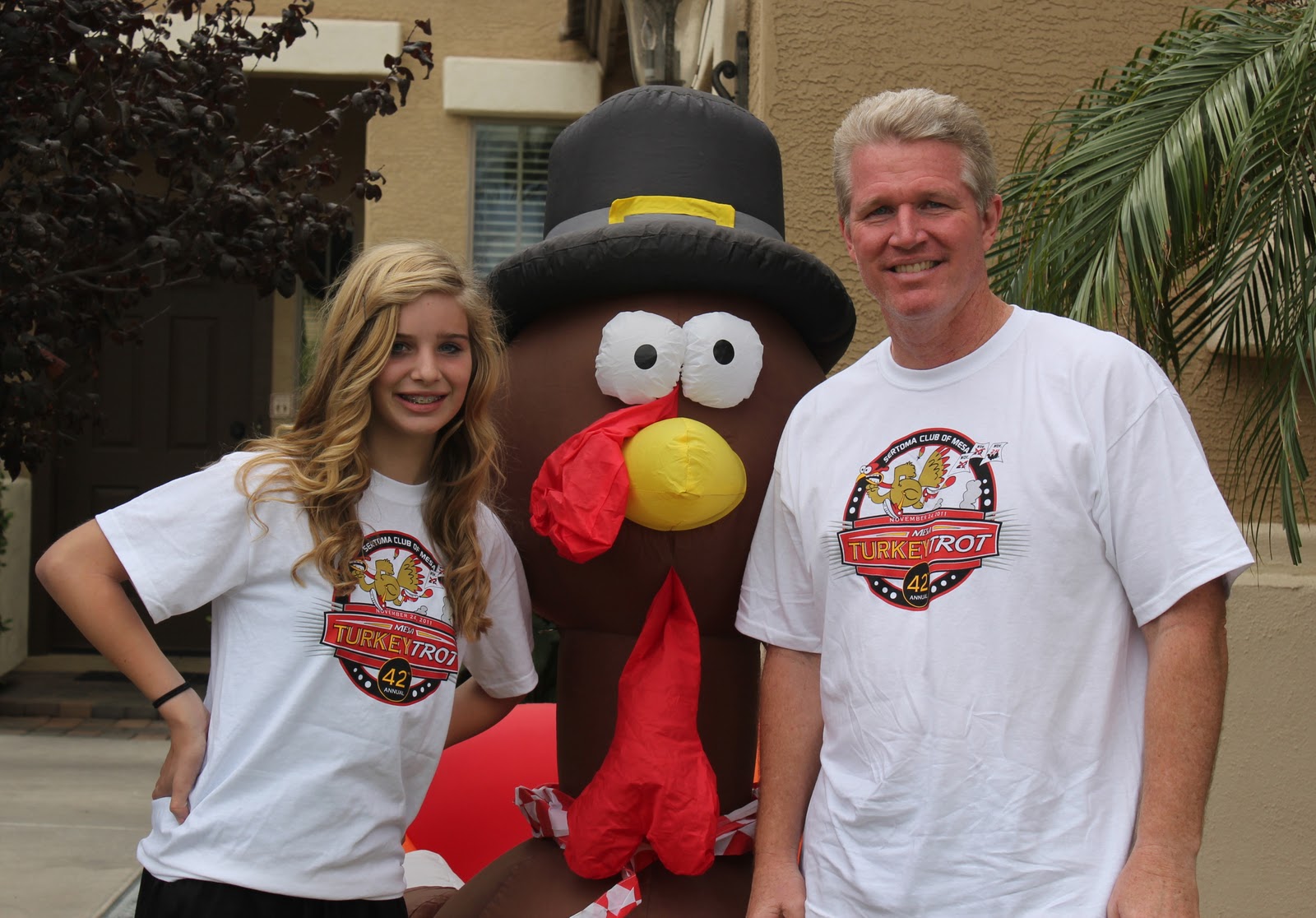
On Thanksgiving Day I ran a Turkey Trot. Well, actually, I ran a Fun Run and a Turkey Trot. My daughter went with me to the race and begged me to run the two-mile fun run with her since she didn’t want to run it alone. (Over two thousand people ran the fun run, so she was hardly “alone.”) I gave in. Consequently, I ran the two-mile run with her (in about eighteen minutes), and then hurried back to the starting line to run the 10K turkey trot.

Decartes said, “I think, therefore I am.” When we engage ourselves in activities that make us look inward at our thoughts , it makes us more alive. As I ran that day, I looked inward and thought about all the sounds I would have missed that day if I had plugged headphones into my ears and cranked up my favorite songs.

I would have missed the conversation with my thirteen year-old daughter. Teenagers have amazing, adaptable minds uncorrupted by the rigid thinking of the adult world. They are alive with wonder and insight that adults have long since lost or surrendered to the perceived realities of life.

I would have missed the nervous chatter of the starting line – “Are you ready?” “How fast do you think you will run it?” “I’ve really got to go pee, but the line is too long.” “Dude, I can’t believe you drank all that vodka last night.”

I might have missed the wail of the air horn as it signaled the start of the race and the runners’ cheers, excited to finally start the race. A police siren announced the coming of the lead runners. During the first half mile the street was lined with jubilant spectators coming to cheer on family members and friends. They shouted encouragement and called out names. I could hear the clicking of cameras.

At the first turn one of the race volunteers was telling everyone to stay to the left. A police bullhorn commanded passing motorists to slow down, and I listened to the quiet hum of his BMW motorcycle.

Then as the crowd settled into its pace, it got eerily quiet. I heard the shuffling of feet against the asphalt. I heard the friction of fabric as running shorts rubbed against thighs. I heard the huffing and puffing of racers striving to get air into taxed lungs. The sound of spitting runners spewing their nervous spittle became evident. I heard the quiet hum of passing traffic. In the distance I heard the music at the finish line teasing me and urging me to hurry.

Just before the one mile point a father stood on the side of the course with three small kids and a boom box playing “Eye of the Tiger.” I heard and felt the thumping beat, the encouraging words, and the wail of the guitar. I heard his daughter crying that she was cold. I heard him shout encouragement and tell his daughter to look for Mommy.

At the one-mile point I heard things like, “We need to speed up,” and “We’re doing good.” I swore I heard the ticking of the clock as it mocked me, and my lack of speed, that morning. Just past the mocking clock volunteers were passing out water. I heard water spilling onto the concrete as runners tried to drink on the run and missed their mouths. I heard, “Thank You,” over and over again as racers thanked the volunteers. I heard the hollow clunk of paper cups as they were tossed aside. I heard gasps for air as racers gulped down the last of their water and sucked in air.

As we turned and headed downhill for a stretch I heard a collective sigh from the crowd. I could hear other people’s headphones. Dogs barked from the nearby neighborhood. Conversations started back up among racers. “He was the Vice President of the company until…” “Yeah, I liked that race. It was fun.” “When is the next water station?” I passed a man pushing two screaming kids in a running stroller.

At the halfway point we passed near the finish line and the cheers of spectators came back. I heard the sound of the port-a-john doors slamming shut. I heard my bladder calling. I heard the sound of my draining bladder. I heard the sound of the air rushing in and out of my lungs as I struggled to catch back up to my race pace.

One runner’s cough sounded like a shotgun going off, and he coughed every ten to fifteen seconds. I hurried past, and gladly put that odd sound behind me.

We turned uphill, and I heard a collective groan go up from the crowd. The ever-present habit of spitting got louder. I heard phlegm hocked up from somewhere deep in the thorax come spewing out through heaving lips and splat against the churning asphalt.

The passing traffic on the busy street got louder. I heard myself going faster with an empty bladder. I heard the clock laughing at me, and my attempts to go faster.

The course turned the corner and headed downhill for the last two miles. Shoes scraped against the course as tired legs lost their good running form to fatigue. Some of the runners were carrying helium balloons. One of them popped.

With about a mile left, I could almost hear the music at the finish line again. I looked up and saw a bright yellow sign that read, “Deaf Child.” I thought about the child who lacked the ability to hear all the things I had taken for granted that morning. I gave thanks for my ability to hear, and all the sounds of the race became even more vivid.

I finished the race strong (for an aging fat guy), and savored the sounds of the race – the shuffling of feet, the huffing and puffing, the spitting, the coughing, the rubbing of cloth, the cheering of spectators, the crying of babies, the humming traffic, the roaring crowd, the ticking of the mocking clock, the music at the finish line. The best sound of the race? My daughter saying, “Good job Dad!”

For the record, I do like to listen to audiobooks or podcasts from time to time when I run.

Land of Milk (and honey)  

Posted by Brock Booher

The best biblical compliment given to any geographic location is a simple phrase - a land flowing with milk and honey. Having traveled a bit, I guess you could say that I consider the quality and quantity of a country’s milk a key indicator of its civilization.

Why milk? Milk is a highly perishable product that requires cleanliness, constant care, and daily effort.

To get milk to market first you need keep cattle that you don’t plan on eating, at least right away. That in and of itself is an indicator that the agricultural capacity of a location can support more than subsistence farming. Second you need a stable workforce. Dairy farmers don’t take vacations. Third you need a sophisticated transportation system that includes refrigeration so that you can get the product to market before it perishes or becomes a health hazard for consumers. Last, you need an enforceable health code to ensure the quality and consumer safety of the product.

Yes, you can call me a milk drinker. Having grown up on a dairy farm, you might say that I am a connoisseur of the world’s milk. Since I don’t drink alcohol, I don’t frequent the local bars and imbibe the local beer, wine, or liqueur when I travel. Instead I head to the nearest supermarket and check out to the dairy department.

A lot of locations produce the sterilized cartons of milk that don’t require refrigeration. I walk right by those shelves. I am looking for fresh moo juice. I don’t care if it comes in bags, bottles, or cartons, but it has to be fresh. Fresh milk lets me know that I am in a civilized place.

Drinkable Peach Yogurt
Yum!
Next I look for the range of varieties and brands. The more variety, like chocolate milk, whole milk, two percent milk, or any other variation of fresh milk, means more sophistication of milk production. More variety of milk means that this connoisseur has choices, and I like choices.

I also pay attention to the quantity of milk available both on the shelf, and per average container. In the US we find shelf after shelf of gallons of the good stuff. In other countries I might only find fresh milk in liter bags. Since I can drink a quart of milk for breakfast without breaking a sweat, I get a warm fuzzy feeling when I find a dairy department stocked full of cold fresh lactated liquid.

After sampling the fresh stuff, I also look for the milk byproducts like butter, cheese, yogurt, or ice cream – especially the ice cream.  Statistically speaking they have proven that people with more education and higher IQ’s eat more ice cream. It doesn’t surprise me since ice cream is the highest form of milk byproducts. I’m just not sure if smart people eat ice cream or eating ice cream makes you smart. I will have to continue my research.

Helado!
I recently returned to Lima, Peru, after fifteen years. One of the first things I did was head to the nearby supermarket and check out the dairy section. I was pleased to see that both availability and variety of milk have improved in my absence. I took great pleasure in sampling the various fresh milk products delivered in one-liter bags. I enjoyed the drinkable peach yogurt produced by Gloria. Of course I had to sample the D’Onofrio ice cream that street vendors sell everywhere. (Based on the ubiquity of ice cream vendors in Lima, they must be some of the smartest people in the world.) After several days of assessment, I would say that Peru has made tremendous strides in the last few years. It has become a land flowing with milk, and that is progress you take to the fridge.

Yes, I’m a milk drinker, a veritable connoisseur of cow juice, a maniac for moo-moo, a disciple of dairy. For me, nothing says “civilization” like a large, well-stocked dairy section in a grocery store. To say that a land flows with milk is a compliment of biblical proportions.

Dairy Section of Supermarket in Miraflores
(No offense meant to all you fans of apiculture. I love honey too, but for me, milk is the bee’s knees.)